Cement plants are among the most complex industrial facilities. They are equipped with heavy machinery, operate in high temperatures and dusty environments, and are subjected to enormous mechanical stresses. Under these extreme conditions, industrial gearboxes are critical components of the power transmission system . They transfer the mechanical energy from the motor or turbine to the various process units. A gearbox failure brings almost all stages of cement production to a standstill.
In this article, we provide a complete explanation of what a gearbox in a cement plant is, how it works, what types exist, what functions it should perform, and why proper maintenance is so important.
The role of gearboxes in cement production
A cement plant operates a variety of equipment, from raw material supply to finished product manufacturing, including crushers, mills, rotary kilns, coolers, concrete mixers, and conveyor belts. All of this equipment requires torque to rotate or move.
The function of a gearbox is to increase the motor torque to the required level while simultaneously reducing the rotational speed to ensure the precise and efficient transport of heavy components.
For example, an electric motor rotates at 1500 revolutions per minute, while a rotary kiln must operate at less than 2 revolutions per minute. This function—reducing the rotational speed and increasing the torque—is precisely the purpose of a gearbox.
Gear type used in cement plants
Various types of gearboxes are used in cement production lines, each specifically designed for its installation location and operating mode. The most important gearbox types in this industry include:
1. Crusher gearbox
In the early stages of cement production, large blocks of limestone and other minerals must be crushed. The gearboxes used in the crushers must withstand extreme shocks, high torques, and continuous mechanical stresses. Heavy-duty cylindrical gearboxes or planetary gearboxes are typically used for this purpose .
2. Raw mill gear
The mill grinds raw materials such as a mixture of limestone, silicon dioxide, and aluminum oxide into a fine powder. The gearbox in this section must operate with high precision and without vibration to ensure uniform granulation. A robust and compact multi-stage planetary gearbox
is used .
3. Oven motor gearbox
Rotary kilns are indispensable equipment in cement plants. These massive kilns rotate at very shallow angles, heating the material to temperatures exceeding 1400 °C.
Rotary kiln gearboxes must be able to transmit extremely high and continuous loads with the utmost precision. They are typically equipped with special cooling systems, heat-resistant bearings, and multi-stage gearboxes .
4. Cement mill gearbox
In the final production step, clinker and gypsum are ground into ready-mixed cement . The gearbox must ensure continuous and efficient operation and be dust-tight.
Planetary or multi-stage cylindrical gearboxes are typically used in this phase.
5. Gearboxes for conveyor belts and elevators
Conveyor belts are used to transport materials between different areas of a factory. These belts typically use worm or spur gear drives, which ensure moderate torque and smooth operation.
Required technical specifications for cement gearboxes
The gearboxes used in the cement industry must withstand extreme operating conditions. Therefore, they have special technical features:
-
The robust and durable housing made of cast iron or steel is vibration and shock resistant.
-
Precision heat-treated and hardened gears
-
Oil cooling systems prevent overheating.
-
Close it tightly to prevent cement dust from getting in.
-
Suitable for high torques and 24-hour continuous operation.
-
Highly precise deceleration is achieved through a multi-stage design.
These properties enable the gearbox to operate continuously and without interruption for many years under conditions of high dust, high temperatures and high pressure.
A well-known brand and an established manufacturer of gearboxes in the cement industry.
Companies such as FLSmidth, SEW Eurodrive, Flender, Sumitomo, and CMD are among the world’s leading manufacturers of industrial gearboxes for cement plants. In Iran, several renowned companies, including Shakrin, Synchron, Shahbaz, Motogen, and Nirogostaran, manufacture and assemble a wide range of high-performance gearboxes suitable for cement production lines.
The importance of regular gearbox maintenance
No matter how robust and durable a gearbox is, its lifespan is significantly reduced without regular maintenance . Here are some of the most important maintenance tasks:
-
The transmission oil must be changed regularly, depending on the operating temperature and the type of oil used.
-
Regularly check gears and bearings for wear or cracks.
-
Monitoring of the oil level and oil quality, including contamination with cement dust.
-
Check for leaks and seals
-
To avoid vibrations, the input and output shafts of the gearbox must be precisely aligned.
-
Pay attention to unusual noises and temperatures , as these may indicate an internal fault.
Regular implementation of these measures extends the service life of the gearbox and reduces downtime in the production line.
Causes of gearbox failures in cement plants
There are many reasons that can lead to gearbox failures or reduced efficiency, including:
-
Continuous operation at design and load temperatures
-
Insufficient lubrication or use of non-standard oil
-
Dust gets into the camera.
-
The engine and transmission shafts are not aligned.
-
Incorrect adjustment leads to excessive wear of the gears.
-
Using a gearbox that is not suitable for the production line capacity .
Any of these factors could lead to production losses, which would be extremely costly for the cement industry.
Restoration and repair of gearboxes made of high-strength concrete
Due to the high cost of high-performance gearboxes, many manufacturers prefer repair or overhaul to complete replacement. Overhauling involves replacing or grinding damaged gears, replacing bearings and seals, and performing precise alignment. A
professional overhaul can save up to 60% of the cost of a new gearbox while restoring its original performance.
The future of industrial gearboxes in the cement industry
Thanks to technological advances, new gearboxes are evolving into intelligent systems . Digital sensors measure temperature, vibrations, pressure, and oil quality in real time and transmit the data to a central online monitoring system. This technology enables the early detection of faults and prevents unexpected failures. Furthermore, new alloys and advanced lubrication technologies have increased gearbox efficiency and reduced energy consumption.
In conclusion
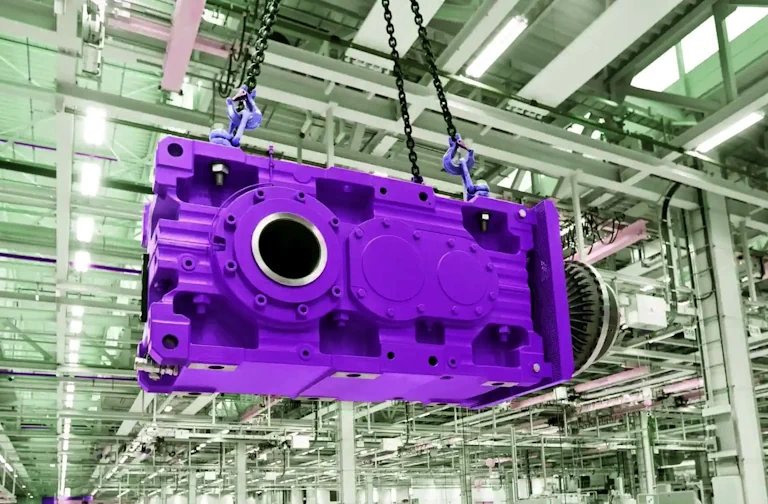
Gearboxes are among the most important mechanical components in cement plants. They transmit power, regulate speed, and deliver the necessary torque for heavy equipment. This component plays a key role in the operation of various plant components such as crushers, mills, rotary kilns, and conveyor belts.
Selecting the right gearbox, regular maintenance, and the use of standard lubricating oil are three crucial factors for maximum service life and efficiency.
In conclusion, it should be noted that although a gearbox may seem like only a small component of a large system, its failure can paralyze the entire cement production line ; therefore, it is important to pay attention to design, maintenance, and the choice of a reliable manufacturer.